

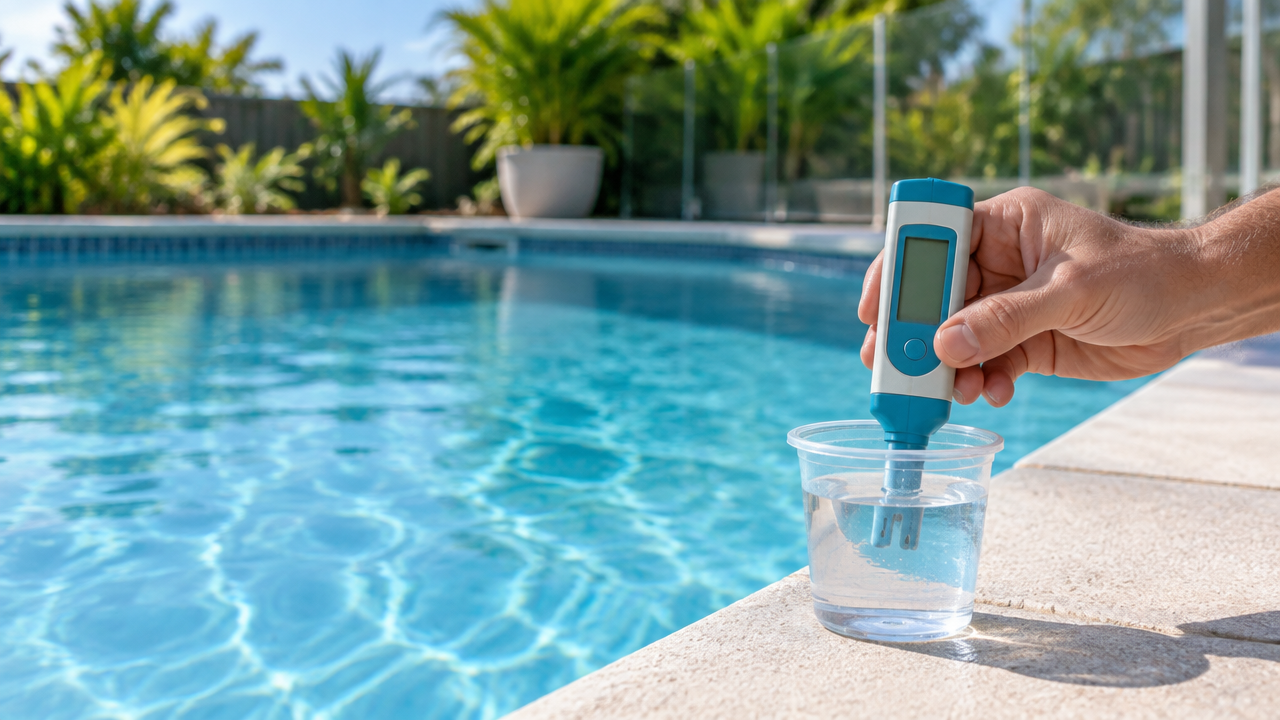
Total dissolved solids (TDS) is a broad reading of material dissolved in your pool water, including minerals, salts and residues from treatment products. It can help you spot a gradual change, but it does not diagnose water quality on its own. For Australian pool owners, the useful question is not simply “Is this number high?” but “What is contributing to it, and does the rest of my water chemistry support taking action?”
Key points for interpreting a pool TDS reading
- TDS is a combined reading, not a breakdown of individual substances.
- Evaporation leaves dissolved material behind, while topping up and adding products can change the total.
- Salt pools naturally have a higher reading because salt contributes to TDS.
- There is no single cutoff that applies to every pool and testing method.
- When a reduction is needed, partial water replacement is the usual approach, not another chemical.
What does TDS include in pool water?
TDS describes the dissolved substances carried in water. In a pool, these can come from the original fill water, salt, minerals and residues left as treatment products dissolve or react. When water evaporates, much of this material stays behind, so the concentration can build over time.
A TDS meter gives a useful overall estimate, but it does not identify which substances make up the result. Two pools with similar readings can have different chemistry, so use the number alongside tests for individual parameters. If you are reading a pool shop report, a guide to understanding pool shop test results can help you make sense of the separate measurements.
Why the number needs context, especially in salt pools
A TDS result is most useful as part of a trend, interpreted against your pool type and the equipment guidance. Published recommendations differ: some guidance for non-salt pools uses figures around 500 to 2,000 ppm, while a Pentair guide lists 3,000 to 6,000 ppm for TDS including salt. Those figures are not interchangeable targets for every pool.
Salt itself contributes to the reading, so saltwater pools start from a different baseline. Check the salt level separately against your chlorinator’s requirements, and avoid treating a salt-inclusive TDS value as if it came from a non-salt pool. For a salt-related result, follow pool-specific salt testing and correction guidance rather than adding or removing salt based on TDS alone.
How TDS differs from other pool chemistry readings
TDS does not replace tests for chlorine, pH, alkalinity, calcium hardness or stabiliser. Those readings tell you about specific parts of the water balance. TDS is a broad total, so it cannot show which chemical is out of range or what treatment, if any, is appropriate.
| Reading | What it helps you assess | What TDS cannot tell you |
|---|---|---|
| TDS | Overall dissolved material and changes over time | Which substances are present or which one needs adjusting |
| Salt | Whether salinity suits your salt chlorinator | Whether other chemistry is balanced |
| Calcium hardness | Calcium level and part of scale or corrosion risk | The pool’s full water balance |
| Chlorine and pH | Sanitiser level and acidity or alkalinity | The total dissolved-solids reading |
For example, a high TDS reading does not prove that calcium is high. Check calcium hardness directly and interpret it alongside the other relevant results, as explained in this guide to pool calcium hardness.
When should you investigate a high reading?
Investigate a result that has risen noticeably from your pool’s earlier readings, especially if you also have persistent cloudiness, scaling or corrosion concerns. These issues can have other causes, so treat TDS as a clue rather than a diagnosis. Check the complete water results, recent chemical additions, top-ups and any large evaporation periods.
Cloudy water, for example, may be linked to several chemistry or filtration problems. Confirm the specific readings and inspect the filter before deciding that TDS is responsible. A pool-aware analysis can help put test results in context, but no single broad reading should trigger a dose of chemicals by itself.
How can you lower dissolved solids safely?
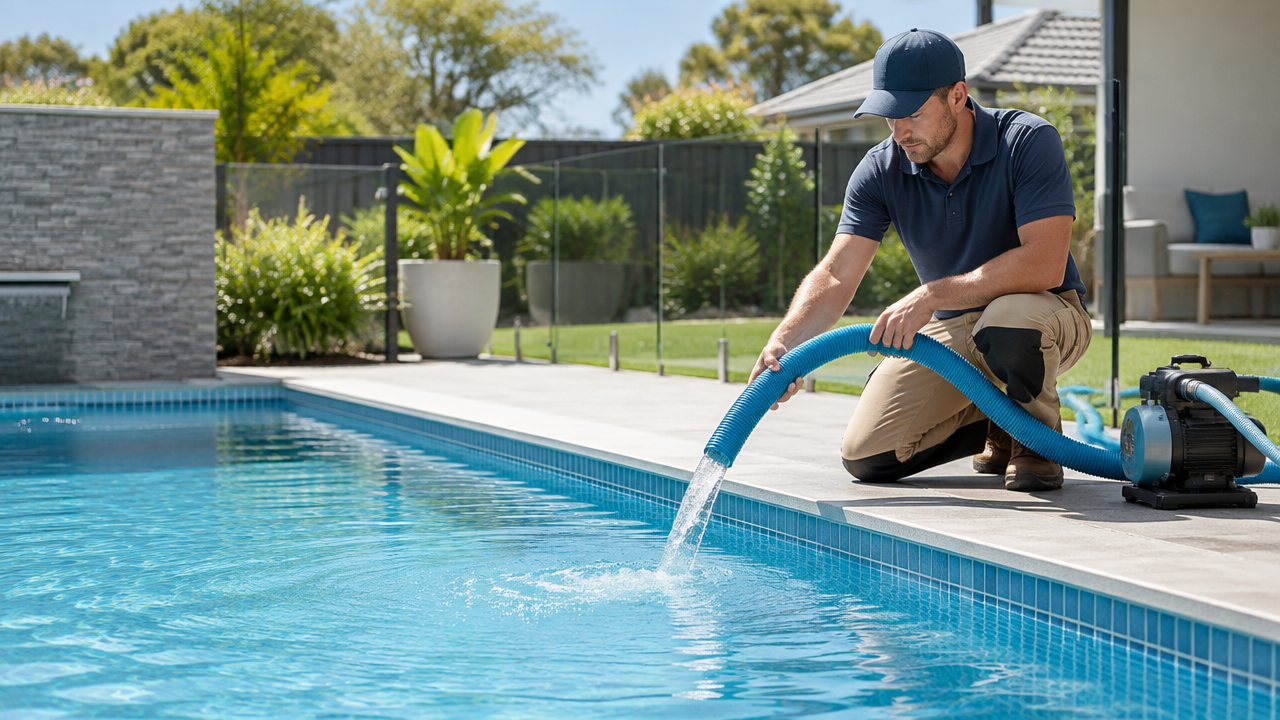
When testing confirms that reducing TDS is appropriate, replacing some pool water with lower-TDS water is the usual option. LaMotte notes that dissolved solids cannot be chemically removed and recommends water replacement when its guidance threshold is exceeded. Check your pool’s own baseline and salt status before acting.
- Retest the water and confirm the result with a reliable pool testing service or meter.
- Check whether the reading includes salt, and compare it with earlier results.
- Test the replacement water if you can, since its dissolved-solids level affects the outcome.
- Ask a pool professional about safe partial draining and refill conditions for your site.
- After refilling, circulate the water and retest individual chemistry readings before making adjustments.
Do not fully drain a pool or assume that adding more chemicals will lower TDS. A controlled partial water replacement can help, but local rules, groundwater and pool construction matter. If you are uncertain about the site or drainage, get professional advice first.
Track the trend, not just one test
A dated history makes gradual changes easier to spot. Record the pool type, salt system, test result, recent top-ups and chemical additions so you can compare like with like. In Queensland, heavy rain, hot weather and evaporation can all change pool conditions, so interpret readings alongside the wider chemistry rather than in isolation.
MyPoolMate helps owners keep pool details and test history together, including results entered manually or read from printed pool shop reports with its AI scanner. Its AI analysis and assistant, Splash, can use your pool’s recorded details to help put results in context and focus on what may actually need attention, instead of recommending extra treatment just because one number looks unfamiliar.
Frequently asked questions
What does TDS mean in pool water?
TDS means the combined amount of dissolved material in pool water, including salts, minerals and residues from treatment products. A reading gives you a broad total, not a list of what is dissolved. It cannot tell you whether chlorine, pH or calcium hardness is in range.
What is a good TDS level for a swimming pool?
There is no single TDS target that suits every pool. Readings depend on the fill water, chemicals added and, in salt pools, the salt itself. Compare results with guidance for your pool type and with its earlier readings, rather than treating one general figure as a pass-or-fail limit.
How do you lower dissolved solids in pool water?
TDS is usually lowered by replacing some pool water with source water that has a lower dissolved-solids level. Before draining, check local rules, the pool’s construction and site conditions, then refill and retest. Avoid fully draining a pool unless a qualified professional confirms it is safe.
Does a saltwater pool have higher TDS?
Yes. Salt is dissolved in the water, so it contributes to a salt pool’s TDS reading. That makes a salt pool’s baseline higher than a comparable non-salt pool. Check salinity separately and compare TDS with the pool’s own earlier readings and the equipment maker’s guidance.
Does high TDS make pool water cloudy?
It can be associated with cloudy water, but a high TDS reading does not identify the cause of cloudiness. Check pH, sanitiser, calcium hardness, filtration and other relevant results before choosing a treatment. Adding chemicals just to lower the TDS number is not the solution.


